
DJ Workshops for Schools
Structured DJ workshops for schools delivered during curriculum time for Pupil Premium, SEND and SEMH learners. Curriculum-linked and aligned with the DfE Enrichment Framework.
Why this matters
GCSE Music entries have fallen by 35% since 2010. 42% of state-funded schools in England no longer enter any students for the qualification. A-level Music entries have dropped by 47% over the same period, and music teacher recruitment has fallen by 56%.
The EBacc and Progress 8 measures have squeezed arts provision out of many schools. The students who would benefit most from creative, practical learning are the ones losing out.
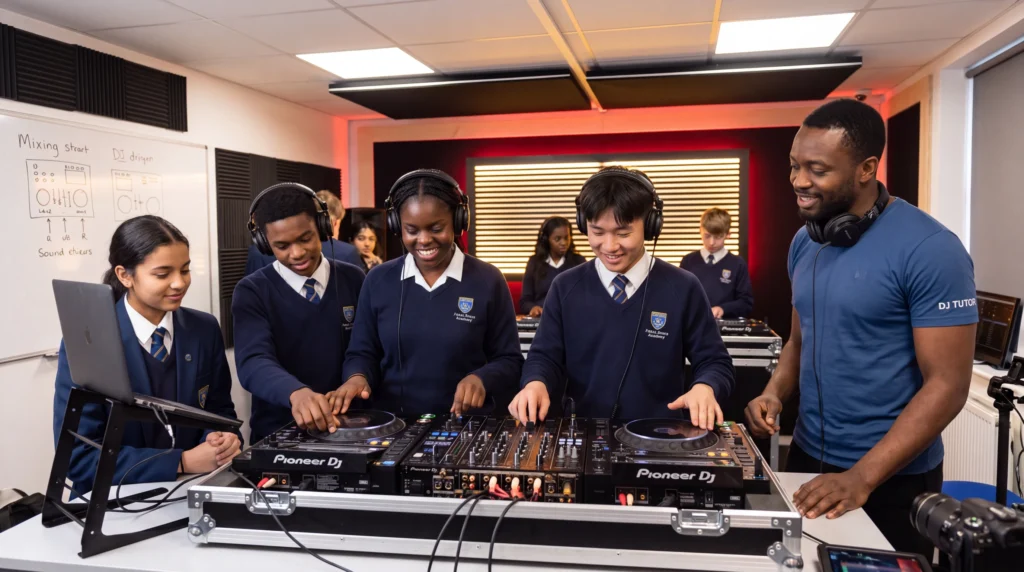
Our DJ workshops for schools fill that gap. We bring professional DJ equipment into your school and deliver structured, term-length courses that give students real music skills without depending on GCSE delivery.
How Our DJ Workshops for Schools Work
We deliver our DJ workshops for schools in half-day visits. Each visit is two 60-minute sessions running back to back, with two different groups of up to 12 students, so one visit covers up to 24 students and each group gets a full session of its own.
Visits run weekly during curriculum time, ideally either side of break or lunch. You book them in blocks of 6 or 10 visits. A block of 6 covers half a term. A block of 10 covers a full term of teaching weeks, which allows for INSET days, trips and exam weeks. Groups stay the same across a block so that skills build week to week.
The programme runs across up to three terms, each covering a different discipline.
Foundations of DJing
Students are introduced to professional DJ equipment and learn the core skills of mixing, blending and performing. Every session is hands-on. By the end of term, every student will have performed in front of their peers.
Topics we cover: equipment handling, health and safety, tempo and BPM, beats and bars, song structure, beatmatching, blending, crossfader technique, EQ mixing, track selection, building a set, peer performance, collaborative back-to-back mixing.
Benefits: students develop focus, timing, patience and confidence. They learn to count in patterns, make quick decisions under pressure, and present their work publicly. The group mix at the end of term builds teamwork and shared ownership of a creative outcome.
Week 1: Welcome and first mix
Meet the group. Ice breaker: everyone picks a track that represents them and plays it to the group. Introduction to the equipment: what each part does, how to handle it safely. By the end of the session, every student has played their first track through the speakers.
Week 2: How music is built
Understanding tempo, beats and bars. Understanding how music is counted in bars of 4 beats and phrases of 8 bars. Listening exercises: students identify the intro, verse, chorus and outro in songs they know. Matching the speed of two tracks using BPM.
Week 3: Beatmatching
Lining up two tracks so they play in time. Students practise matching beats by ear, adjusting the tempo, and using the pitch fader. This is the skill that separates pressing play from actually DJing.
Week 4: Blending and transitions
Moving smoothly from one track to the next. Students learn when to start the blend, how to use the crossfader, and how EQ (bass, mid, treble) keeps the mix clean. Each student practises a full transition.
Week 5: Building a set
Students choose 3-4 tracks and plan the order. They think about energy, mood and how each track flows into the next. Each student prepares a short set to perform next week.
Week 6: Group showcase
Each student performs their set for the group. Peer feedback: what worked, what they enjoyed, what they’d do differently. The session ends with a collaborative back-to-back mix where everyone contributes one transition to a continuous group set. Foundations Certificates presented.
For 8-week terms, weeks 5-6 extend into deeper practice, individual feedback sessions, and a longer showcase.
DJ Club CIC Foundations Certificate awarded
Sampling and Production
Students move beyond the decks and into music production. Using digital audio workstations, they learn to create beats, sample sounds and build their own tracks from scratch. The term ends with a group project where everyone contributes to a single collective track.
Topics we cover: digital audio workstations (DAW), navigating production software, sound libraries, sampling, loop creation, drum patterns, rhythm and timing, layering sounds, song arrangement, recording audio, editing, mixing a track, group collaboration on a shared production.
Benefits: students develop digital literacy, attention to detail and creative problem-solving. They learn how music is constructed from individual elements, how to listen critically, and how to contribute their own work to a shared project. Every student finishes the term with something they made from scratch.
Week 1: Welcome back and introduction to the DAW
Ice breaker for returning students and any new group members. Introduction to the software: what a DAW is, how to navigate it, where sounds live. Students create a simple 4-bar loop before the session ends.
Week 2: Samples and loops
What a sample is and where they come from. Listening to how professional tracks use samples. Students browse sound libraries, choose their own samples, and layer them into a short loop.
Week 3: Building a beat
Drum patterns, rhythm and timing. Students build a beat from scratch using kicks, snares, hi-hats and percussion. They learn about patterns, repetition and how small changes affect the feel.
Week 4: Layering and arrangement
Adding melodic elements on top of the beat. Students learn about verse and chorus structures, how to build energy, and how to arrange sections into a full track layout.
Week 5: Recording and editing
Students record their own audio: a vocal sample, a sound effect, a clap pattern. They learn to edit recordings, trim them, and drop them into their tracks. This is where each student’s track starts to sound different from everyone else’s.
Week 6: Group track and playback
Each student contributes their best section to a single group track. The instructor helps stitch the sections together into one continuous piece. The group listens back, discusses what they built, and each student receives their Producer Certificate.
For 8-week terms, weeks 5-6 expand into mixing techniques, effects processing, and a more polished group production.
DJ Club CIC Producer Certificate awarded.
Sound Engineering and Performance Showcase
The final term focuses on the technical and practical skills needed to run a live music event from the ground up. Students learn sound engineering, microphone technique and event delivery, then plan and perform a live showcase for parents, staff and peers.
Topics we cover: PA system components, signal flow, cable management, gain staging, speaker placement, acoustics and feedback, microphone technique, voice projection, MCing and speaking over music, crew roles (DJ, MC, sound engineer, event coordinator), event planning, running orders, technical rehearsal, live performance.
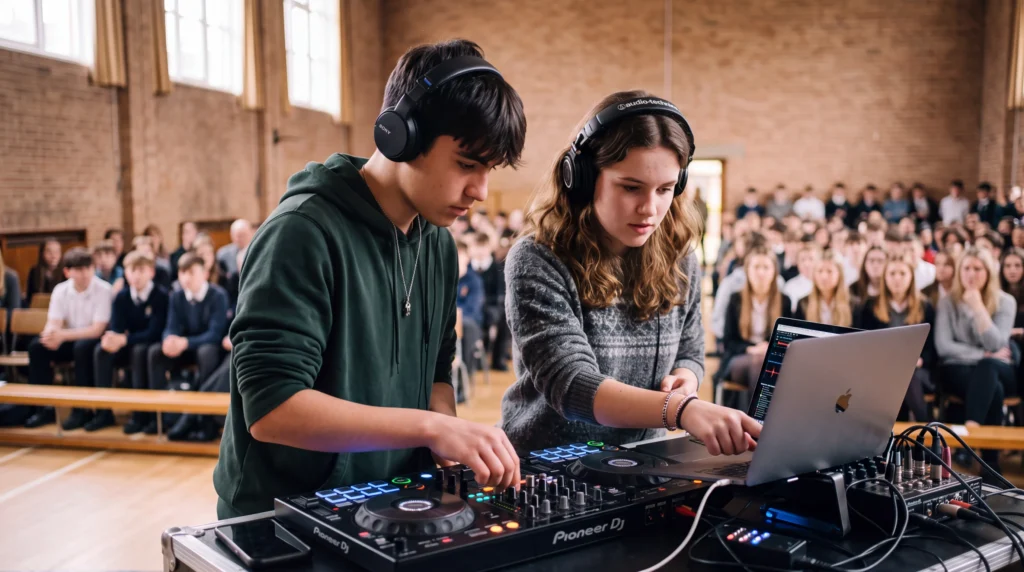
Benefits: Students develop responsibility, teamwork and real-world problem-solving. They learn technical skills that apply directly to careers in music, events and media. The showcase gives every student a defined role and a public moment of achievement in front of people who matter to them.
Week 1: Welcome back and introduction to sound
Ice breaker: students share what they remember from Terms 1 and 2 and what they’re most looking forward to. Introduction to the PA system: what each component does, how sound travels from the source to the speaker, and why it matters.
Week 2: Setting up a system
Students set up the PA from scratch. Connecting speakers, running cables, gain staging (setting the right levels so nothing distorts), and troubleshooting when something doesn’t work. By the end of the session, they’ve built a working system and tested it.
Week 3: Monitoring and acoustics
Where to place speakers in a room. What feedback is and how to prevent it. How the room itself changes the sound (hard walls vs soft furnishings, big spaces vs small). Students experiment with speaker positioning and listen to the difference.
Week 4: Microphone skills and MCing
How to hold a mic, how close to stand, how to project without shouting. Students practise speaking over music: introducing a track, hyping up the room, interviewing a partner. For many students, this is the biggest confidence step of the whole programme.
Week 5: Crew roles and event planning
Students are assigned roles for the showcase: DJ, MC, sound engineer, event coordinator. They plan the running order, decide who performs what, write the MC script, and run through the technical setup. This is project management through music.
Week 6: Live showcase
The event itself. Students set up the PA, run the sound, MC the show, and DJ for an audience of parents, staff and peers. Every student has a defined role. Graduate Certificates are presented at the end.
For 8-week terms, week 6 becomes a technical rehearsal and week 7-8 is the showcase, with time for refinement and a longer performance.
DJ Club CIC Graduate Certificate awarded.
Students who complete all three terms leave with practical skills in DJing, music production and live sound, plus three certificates recognising their progress. For students who want to continue, DJ Club CIC offers ongoing community sessions, events and opportunities to develop further.
Parents can also book individual sessions and holiday workshops for their children.
Curriculum Links
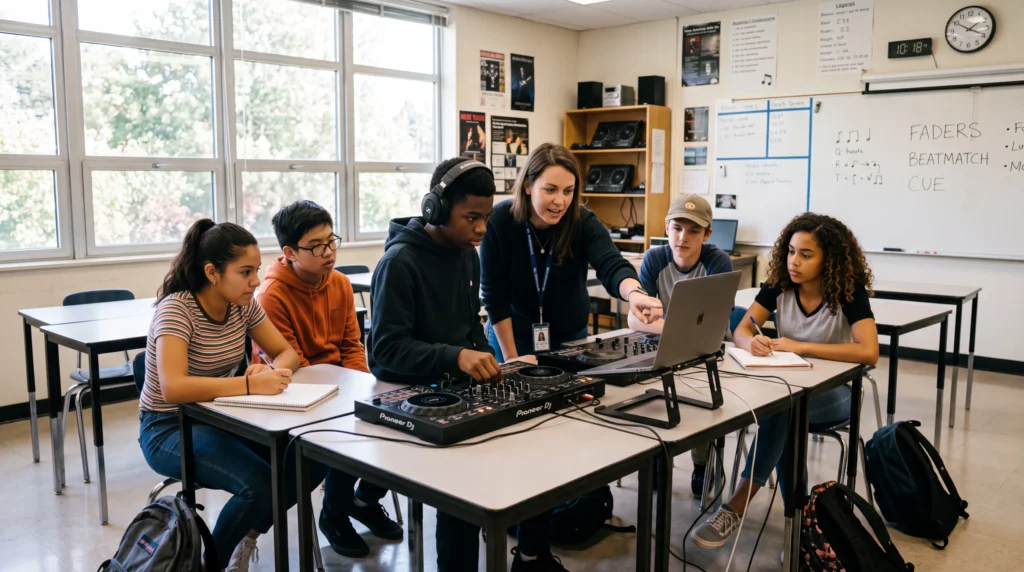
Every session connects to the national curriculum. Students apply classroom knowledge in a practical setting without it feeling like a lesson.
Maths
BPM is a rate (beats per minute). Beatmatching requires counting in multiples of 4, 8, 16 and 32. Phrasing works in patterns of 8 bars. EQ adjustments involve fractions and percentages. Gain staging uses decibel ratios.
Science
Sound is physics: frequency, amplitude, waveforms. PA setup covers electrical circuits, signal flow and acoustics (reflection, absorption, feedback). Music production introduces digital sampling rates and audio compression.
English
MCing builds verbal fluency, audience awareness, tone and projection. Peer feedback sessions develop critical vocabulary. Event planning involves written briefs, running orders and promotional material.
Music
Song structure, tempo, rhythm, phrasing, harmony, key matching, remixing and live performance. Students engage with the full music curriculum through practical application.
PSHE
Self-expression through music, building confidence through performance, managing nerves, teamwork, respecting different tastes and cultures, and digital safety when sharing music online.
Meeting the DfE Enrichment Framework
In June 2026 the Department for Education published its Enrichment Framework, setting out eight benchmarks for schools to evaluate their enrichment offer. From September 2026, Ofsted will consider how schools have regard to this framework when assessing personal development.
For most schools, the challenge is not whether to offer enrichment but how to evidence it. Activities need to be broad, accessible, tracked, and delivered in partnership with credible external providers.
Our DJ workshops for schools are built to help you meet four of the eight benchmarks directly. Here is how.
Benchmark 2: A broad and well-rounded offer
The framework identifies five enrichment categories, one of which is Arts and Culture. DJing, music production and sound engineering sit clearly within this category while offering something distinct from traditional music provision. For students who have not engaged with instrumental lessons or choir, this is a genuine alternative route into the arts.
Benchmark 3: Accessible to all
Sessions are designed for all abilities, including SEND learners and students with social, emotional and mental health needs. We bring every piece of equipment, so there is no cost to students or families and no barrier to participation. Groups are capped at 12 so every student gets meaningful hands-on time rather than watching from the back.
Benchmark 5: Tracked and evidenced
We provide a termly report for every group covering attendance, engagement scores, skills progression and a written summary for each student. Students who complete each term receive a named certificate. This gives your school documented evidence of participation and outcomes that can be presented to governors or included in your Ofsted evidence base.
Benchmark 6: Partnership with external providers
DJ Club CIC is a registered community interest company with governance documents, safeguarding policies, DBS-checked staff and public liability insurance in place. All documentation is available on request. Schools can evidence this partnership confidently in their enrichment records.
A note on the other benchmarks
Benchmarks 1, 4, 7 and 8 relate to school-level strategy, leadership, staff development and long-term planning. These sit with your school rather than with an external provider. We are happy to contribute to your enrichment planning discussions and provide any documentation you need to support your self-evaluation against the full framework.
Try Our DJ Workshops for Schools
We know committing to a term is a big decision. Here is how to start.
We bring the equipment into your school for 30 minutes with a small group. No obligation. The best way to see how students respond.
Price: Free
Only 6 Sessions Left
Two weeks of the Term 1 course with 12 students. Long enough for students to learn real skills. If you convert to a full term, the cost is credited against the term price.
Price: £500
A full-day hands on DJ workshop for a whole year group. All equipment and setup included. Ideal for schools that want to test the concept at scale before 100% committing.
Up to 60 students in groups of 12, across 5 sessions
Price: £1200
Investment
Our DJ workshops for schools are charged as a flat weekly rate for the school, not per student. This keeps budgeting simple and ensures cost does not become a barrier to any individual student’s participation.
Pricing depends on the number of terms you book, the group structure you choose, and the length of your school terms. All prices include equipment, certificates, termly progress reports and the end-of-year showcase event.
These rates are eligible for funding through Pupil Premium, SEND budgets, enrichment allocations and other school-held funding streams. We can provide invoicing and documentation to support your internal procurement processes.
A half-day visit is £600 in Term 1 and £660 in Terms 2 and 3, charged for the whole booking rather than per student. Each visit covers two groups, so that reaches up to 24 students.
Most schools start with a block of 6, which covers half a term at £3,600. That reaches 24 students, which works out at £150 per student for the half term, or £25 per student per session. A block of 10 covers a full term at £6,000.
If you would rather try it before booking a block, a trial half day is £600 and a trial full day is £900. Either is credited in full against any block booked in the same academic year.
A visit is around five hours of our time once travel, setup and pack-down are counted, and brings several thousand pounds of equipment on site along with headphones for every student, £5 million public liability cover and an enhanced DBS-checked instructor. Reporting and certificates are included.
Download our full proposal for detailed pricing across all three terms, or book a free demo and we can discuss what works for your budget.
Blocks are invoiced in two instalments, 50% on confirmation and 50% on completion, with 30 day terms. We accept purchase orders and quote your PO number on both invoices. Visits cancelled with more than 48 hours notice are rescheduled at no cost.
Alternative provision, PRUs and special schools
We deliver in alternative provision as well as mainstream schools. The programme content is the same. The delivery model and the rate are different.
What changes
Groups are capped at 8 rather than 12. Sessions are built to work whether 8 students turn up or 3, and we do not charge for absences. Reporting is per student rather than per group, with named engagement observations. We adapt delivery as standard for fine motor control, processing time and sensory needs, at 3 levels: adapted mainstream sessions, accessible DJing using large colour-coded pads, and sensory music sessions assessed against the Sounds of Intent framework.
The rate
A half-day visit is £800, covering 2 sessions with 2 groups of up to 8. A block of 6 visits is £4,800 and a block of 10 visits is £8,000. A trial half day is £800 and a trial full day is £1,200, credited in full against any block you go on to book.
Why it differs from our mainstream rate
Our mainstream rate is £600 a visit reaching 24 students, which is £25 per student. The alternative provision rate is £800 reaching 16 students, which is £50 per student. The difference is group size. The same instructor, the same hour and the same equipment across fewer students costs more per student. For context, alternative provision commissioning in London tends to sit around £68 per pupil hour. We are at £50, with all equipment and reporting included.
Equipment We Bring
One of the best things about our DJ workshops for schools is everything is provided. Your school needs to supply a room and access to power, nothing else. Students never need to bring or buy anything.
| Item | Quantity | Notes |
|---|---|---|
| DJ controllers | 3 | Pioneer DDJ series or equivalent, USB powered via laptop |
| Laptops | 2 | Pre-loaded with DJ software and a digital audio workstation |
| Headphones | 12 | One per student. Over-ear, closed-back |
| Portable PA speaker | 1 | Compact powered speaker, set to classroom volume |
| Microphone and stand | 1 | For Term 3 microphone and presentation work |
| Audio interface | 1 | For Term 2 production sessions |
| Cables, power strips and adaptors | As needed | All supplied |
| Portable DJ stand | 1 | Used where no suitable desk is available |
What we need from you
| Requirement | Detail |
|---|---|
| Room | A classroom, hall or music room. Space for a desk and 12 students seated or standing |
| Power | Two standard sockets minimum. We bring our own power strips |
| Setup time | 15 minutes before the session and 15 minutes after |
| Staff | A member of school staff present throughout, per your safeguarding policy |
Noise levels
We set the PA to classroom volume, not performance volume. Students monitor through headphones for most of each session, so the room stays quieter than a typical music lesson. For the Term 3 showcase we will discuss volume and timing with you in advance, and we are happy to work around exams, assemblies or lessons in adjacent rooms.
Safety and reliability
All electrical equipment is PAT tested annually. A written risk assessment covering electrical safety, cable management, trip hazards, noise exposure and student welfare is available on request, and we are happy to complete your own contractor or visitor risk assessment paperwork.
We carry duplicate controllers, laptops and cables. Equipment failure does not cancel a session.
SEND and Accessibility
Our DJ workshops for schools are designed to include students who often miss out on music provision. We work at three levels depending on the group.
Adapted mainstream delivery. Our standard three-term programme with adjustments: lower volume, predictable session structure, longer processing time, and fewer transitions per session. Suitable for students with autism, ADHD, or physical disabilities who can access the full curriculum with the right conditions.
Accessible DJing. For students with moderate learning difficulties or limited fine motor control. Large illuminated colour-coded pads replace small controls, and students build tracks by choosing and layering sounds rather than beatmatching. Same creative outcome, different route to it.
Sensory music sessions. For students with profound and multiple learning difficulties. Sessions focus on cause and effect, agency and choice-making, using touch and movement-triggered sound. Progress is assessed using the Sounds of Intent framework rather than our standard skills ratings.
Working with your existing equipment
Many SEND settings already own assistive music technology such as Soundbeam that is not being used because staff have not been trained on it. If that sounds familiar, we can deliver sessions using your equipment and provide staff training so your team can continue the work between our visits.
Tell us what you have and what your group needs, and we will build the sessions around it.
Safeguarding
We work with children and young people every day and treat safeguarding as the foundation of everything we deliver.
| DBS | Enhanced DBS check with children’s barred list for every instructor |
| Training | Level 1 safeguarding awareness and Prevent training completed |
| Policy | Full safeguarding policy, reviewed annually |
| Insurance | Public liability insurance of £5 million minimum, specifying work in schools with children |
| Risk assessment | Written assessment covering electrical safety, cable management, noise levels and student welfare |
| Equipment | All electrical equipment PAT tested annually |
| Supervision | A member of school staff present throughout every session |
Your policies apply
Your school’s safeguarding and behaviour policies take precedence during our sessions. We ask for a copy of your behaviour policy and the name of your Designated Safeguarding Lead before the first session, and our instructor will follow your reporting procedures if any concern arises.
Photography and video
We do not photograph or film students without your written consent and confirmation that parental consent is in place. Where consent is given, images are used only as agreed with your school. Consent can be withdrawn at any time.
Music content
All music used in sessions is age-appropriate and checked by the instructor in advance. Students can suggest tracks but nothing is played without being checked first. We do not play tracks containing explicit language or themes.
Documentation
All documents are available on request, and we are happy to complete your own contractor vetting or visitor risk assessment paperwork before the first visit.
Frequently Asked Questions
Groups and students
Why only 12 students?
We bring 3 controllers and headphones for every student, so at 12 no more than 4 share a station and everybody gets a real turn. Above that, some students end up watching rather than doing, the learning drops off and behaviour becomes harder to manage. We would rather deliver well to 12 than adequately to 30.
We have a class of 30. How does that work?
That works well. Every visit is two back-to-back sessions with two different groups of up to 12, so 24 students are covered in one morning as standard. A full day covers three groups and 36 students. If you want an entire year group to experience it, a year group day covers up to 60 students across five rotating sessions.
Can the group change mid-term?
We recommend keeping the same group throughout for continuity, as skills build session to session. Changes are straightforward in the first two weeks. After that it is at the instructor’s discretion, because a student joining in week five will struggle to catch up.
What if a student misses sessions?
They rejoin at the next session and the instructor brings them up to speed during the practical element. If a student misses three or more consecutively we will flag it with your named staff contact. Attendance patterns are included in the termly report.
Can we book a single session? We book by the half day, which is two back-to-back sessions with two different groups. It is how we cover travel and setup, and it is what keeps the rate where it is. It also means a visit reaches 24 students rather than 12, so the cost per student is lower than a single session would be.
Is this suitable for SEND students?
Yes, and it is where the programme often has the most impact. We deliver at three levels: our standard programme with adjustments for autism, ADHD or physical disabilities; accessible DJing using large colour-coded pads for students with limited fine motor control; and sensory music sessions for students with profound and multiple learning difficulties. Tell us about your group and we will build sessions around it.
What age groups do you work with?
Key Stage 2 through to Key Stage 4 for the school programme, and we work with young people from age 3 to 21 across our wider provision. Content is adapted for each age group.
Delivery and logistics
What do we need to provide?
A room with two power sockets and a member of staff present. That is it. We bring all equipment including headphones for every student.
How long does setup take?
Fifteen minutes before the session and fifteen minutes after. We work around your timetable.
How loud is it?
Quieter than a typical music lesson. Students monitor through headphones for most of each session and the PA is set to classroom volume. For the Term 3 showcase we agree volume and timing with you in advance.
Can sessions be moved for INSET days or school events?
Yes. We ask for as much notice as possible and reschedule within the same term. The six to eight week structure has flexibility built in for exactly this reason.
What happens if your equipment fails?
We carry duplicate controllers, laptops and cables. Equipment failure does not cancel a session.
Do you work with multi-academy trusts?
Yes. If several schools in your trust are interested we can discuss delivery across sites and a trust-level agreement.
Safeguarding and behaviour
Who manages behaviour?
Your school’s behaviour policy applies. A member of school staff must be present throughout. Our instructor runs the session and redirects low-level disruption, but anything more serious is referred to your staff following your procedures.
What are your safeguarding arrangements?
Enhanced DBS with children’s barred list, safeguarding and Prevent training, a full safeguarding policy and a written risk assessment. We ask for your behaviour policy and the name of your Designated Safeguarding Lead before the first session. All documentation is available on request.
What music is played in sessions?
All music is age-appropriate and checked by the instructor in advance. Students can suggest tracks but nothing is played without being checked first. No explicit language or themes.
Is the music licensed?
Schools hold PRS for Music and PPL licences through the Copyright Licensing Agency education agreement. Our sessions fall within that existing cover, so no additional licence is needed.
Do you take photographs of students?
Only with your written confirmation that parental consent is in place, and only used as agreed with your school. Consent can be withdrawn at any time. We are happy to deliver without any photography.
Booking, pricing and reporting
How do we start?
You can book a trial half day or full day, a block of 6 visits, or a full block of 10. Both trials are credited in full against any block you go on to book.
Do we have to commit to all three terms?
No. Schools can book a single term. The three-term structure delivers the strongest progression and we offer a discount for full-year commitment, but there is no requirement.
Can we start mid-year?
Yes. Most schools start with Term 1, but if you want to begin in the spring or summer term we will start at the beginning of the programme rather than dropping students into Term 2 or 3.
How is this funded?
Schools typically use Pupil Premium, SEND budgets, enrichment allocations or alternative provision commissioning. We provide invoicing and documentation to support your procurement process, and we are happy to talk through which budget line fits best.
What evidence do we get?
A termly report covering attendance, engagement scores, skills progression, a before-and-after confidence survey and a written summary for each student. It is designed to be used directly as Pupil Premium impact evidence or in your Ofsted personal development evidence base. You can see a sample report on this here.
What is your cancellation policy?
Sessions cancelled with more than 48 hours notice can be rescheduled within the same term at no cost. Less than 48 hours notice is charged at the standard rate. Sessions cancelled by us are always rescheduled at no cost.
Do students need to buy anything?
No. All equipment is provided and there is no cost to students or families at any point.
Next Steps
Read the detail
Our full proposal covers the three-term structure week by week, pricing across all terms, safeguarding documentation and how we report progress.
Have a conversation
If you would rather talk it through before committing to anything, email oliver@djclub.org.uk and we will find a time. No pitch, just a conversation about whether this fits your school.
See it in action
We are offering a limited number of free demo sessions to schools in Havering and the surrounding area for the autumn term. We bring the equipment, run a hands-on 30-minute session with up to 12 students, and your staff observe. Around an hour on site including setup.
Demos are most useful when whoever would make the decision about enrichment spend can watch students respond first-hand.
Demos are first come, first served. If the autumn slots are fully booked we will offer a trial half day instead, which gives two of your groups a session each and is credited in full against any block you go on to book.
We currently deliver across Essex and East London. If your school is outside this area, get in touch anyway and we will let you know when we expand to your region.