DJ and Music Technology Workshops in Essex and London
Enrichment programmes for schools, young people and adults.
Aligned with the DfE Enrichment Framework. All equipment provided.
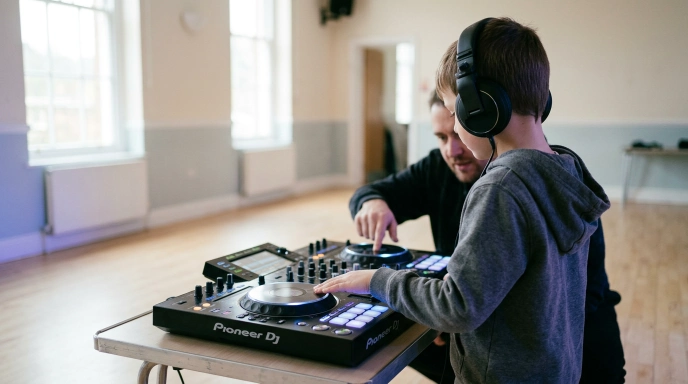
Students get hands on professional DJ equipment from the first session. They learn to mix, produce and perform their own music across a structured programme that runs for up to three terms. No experience needed. We bring everything.
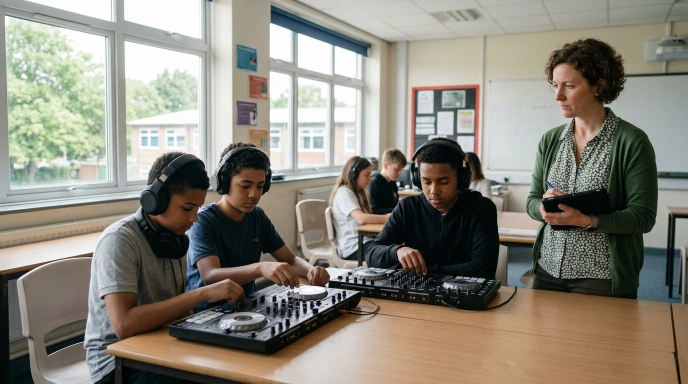
We work in schools with groups of up to 12, including Pupil Premium, SEND and SEMH learners. Every term ends with a named certificate and a progress report for the school.
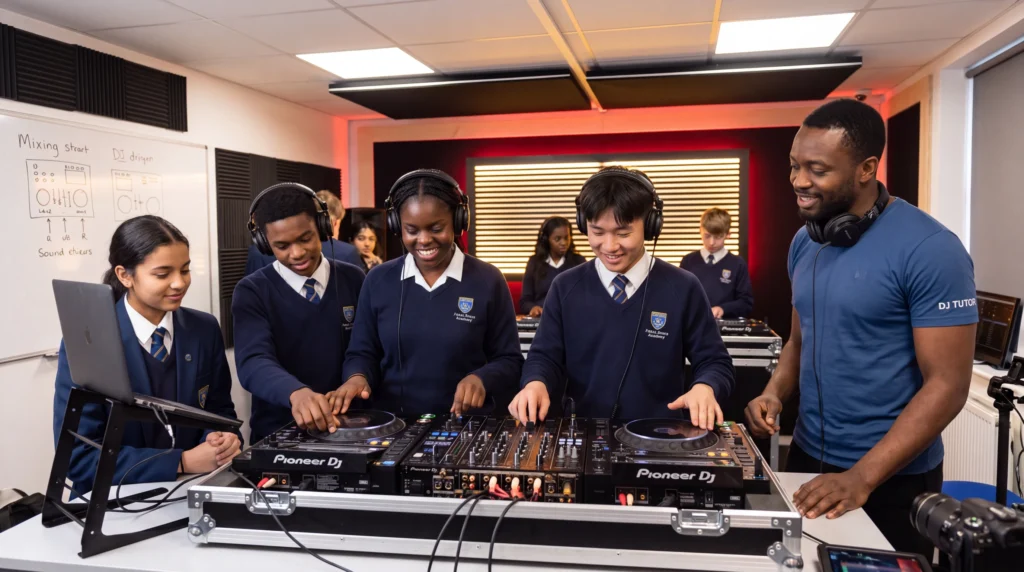
Teaching young people to mix, produce and perform.
DJ Club CIC is a community interest company based in Essex and London. We deliver DJ and music technology workshops in schools, working with groups of up to 12 students including Pupil Premium, SEND and SEMH learners. All profits go back into music education.
Why DJing matters
Every session links directly to the national curriculum across maths, science, English, music and PSHE. Students learn by doing: counting beats is maths, understanding sound is physics, presenting a set is public speaking.
In England’s poorest areas, 54% of schools enter no students at all for GCSE Music. In the wealthiest, it is 21%. DJing reaches the young people who traditional music education has left behind.
Music Theory & Practical Performances
Students learn song structure, phrasing, rhythm and key. They hear how tracks are built, then apply it by mixing and producing their own. By Term 3 they plan, rehearse and deliver a live performance.
Topics covered: song keys, song structure, rhythm and phrasing, harmony, key matching, track form, beatmatching, layering, basic production.
Benefits: Students learn to read song structure by ear: where the intro ends, where the chorus hits, where the breakdown opens up space for a transition. They develop a working understanding of key, phrasing and rhythm through mixing tracks they already know. By Term 2 they are deconstructing songs and building their own. No notation, no theory worksheets. The theory is in the mix.
Counting, Timing and Patterns
Beatmatching is counting. Students work with BPM, time signatures and bar lengths to get two tracks running together. They calculate tempo differences, count in multiples of 4, 8, 16 and 32, and learn that every mix is built on repeating mathematical patterns.
Topics covered: BPM calculation, tempo and time signatures, counting beats and bars, phrasing in multiples, fractions in timing, tempo matching.
Benefits: Students practise mental arithmetic, pattern recognition and timing in a setting where getting it right has a result they can hear. The maths is the same as in the classroom. The motivation is not.
Sound, Signal and Equipment
Your heartbeat keeps time. Your voice is a waveform. The bass in your favourite song is a frequency you feel before you hear it. Sound is already part of how students experience the world. Our sessions give them the language and the equipment to understand why.
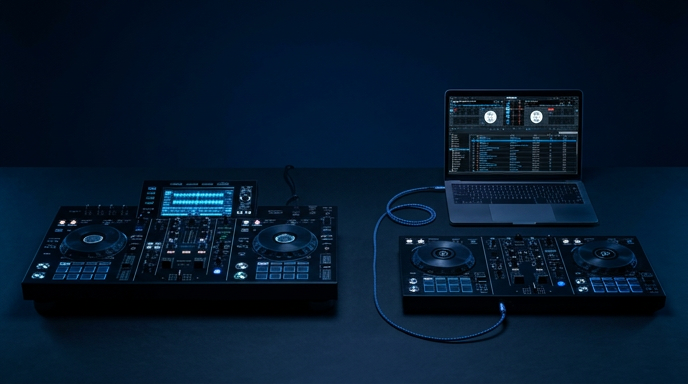
Students work with professional audio hardware: mixers, controllers, headphones and speakers. They follow a signal from source to speaker, hear what EQ does by cutting the bass from a live track, and learn about safe listening levels through the headphones they are wearing.
Topics covered: sound waves, pitch and frequency, EQ (bass/mid/treble), acoustics, signal flow, safe listening levels, DJ software, MIDI basics, sampling and looping, file and library management.
Benefits: Students see science respond to their input in real time. Turning a low-frequency knob and hearing the bass disappear teaches EQ faster than a diagram. By Term 2 they are navigating DAW software, managing files and producing audio from scratch. These are transferable digital skills with direct routes into music technology, broadcast, live events and audio engineering.
Presenting, Listening and Responding
A DJ set tells a story without words. But the rest of the session is built on language. Students describe what they hear, explain their choices, give feedback to each other and receive it back. In Term 3 they MC and host a live event in front of an audience.
These are English skills practised in a setting where students want to talk because they care about what they are making.
Topics covered: verbal communication, active listening, descriptive language, peer feedback, public speaking, MC skills, event hosting, set-list narrative and sequencing.
Benefits: Students who struggle to speak up in a classroom will often talk confidently about a mix they have just made. The subject matter gives them something concrete to describe, and the small group size means they are heard. By the end of Term 3, every student has stood in front of an audience and spoken into a microphone.
Confidence, Identity and Teamwork
A student who completes a mix and plays it back to their group has done something they did not know they could do. That is what most of PSHE looks like in our sessions. It is not taught as a separate topic. It happens because the work itself asks for it.
Students share equipment, wait their turn, give honest feedback and receive it. They make creative decisions and own the result. For students who have disengaged from academic settings, finishing something and having it recognised is often the thing that was missing.
Topics covered: self-esteem, confidence building, teamwork, turn-taking, giving and receiving feedback, managing pressure, creative identity, resilience, emotional regulation through music.
Benefits: Every term ends with a named certificate and a moment where the student’s work is heard by others. That structure gives students something to work towards and a visible record of what they achieved. Teachers consistently report that students who are difficult to engage elsewhere will focus and participate in DJ sessions because the activity meets them where they are.
Self-Expression and Creative Decision-Making
Every mix is a series of choices. Which track to play, when to bring it in, how to shape the transition, what comes next. There is no correct answer. Students develop their own taste and their own style, and they learn that creativity is a skill you practise rather than a talent you either have or do not.
By Term 2 they are producing original music. By Term 3 they are planning and delivering a live showcase event. The creative decisions get bigger as the programme progresses, and students own every one of them.
Topics covered: curation, sequencing, remixing, live arrangement, personal style, improvisation, creative problem-solving, performance, staging, artist identity.
Benefits: This is the Arts and Culture strand of the DfE Enrichment Framework in practice. Students create original work, present it to an audience, and build a portfolio of recorded output they can keep. For UCAS applications, college portfolios, or simply a record of what they achieved, the work is real and it belongs to them.
Our DJ Workshops
A three-term enrichment programme that links to maths, science, English, music and PSHE. Students start by learning to mix, move into music production, and finish the year planning and running a live showcase. Groups of up to 12, all equipment provided, and every term ends with a named certificate and a progress report for the school. Built for the students who switched off in the classroom and need a reason to switch back on.
Group workshops, holiday programmes and one-to-one sessions for ages 3 to 21. Students get behind professional DJ equipment from the first session, learn at their own pace, and build skills they can keep. No experience needed, nothing to buy, and groups are small enough that nobody spends the hour watching someone else. For young people who have finished the school programme, there is a route into presenting on HIGHR Essex, our community radio station.
Beginner courses, one-to-one lessons, parties with a competition and a trophy, and corporate team sessions with four DJ stations, a full PA, lighting and a host on the mic. Whether you are picking up a skill you have been meaning to learn or booking something your team will actually talk about afterwards, we bring everything and set it up wherever you are.
What to expect
Our sessions are held in a judgement free zone with all abilities, skill levels and cultures are welcome.
- Unlock and express your creativity
- Mix your favourite songs
- Learn new musical skills
- Create new connections
- Get hands on with professional DJ gear
- Build your overall confidence and mental wellbeing