Children can start learning to DJ with us from the age of 3.
Almost nobody arrives having done it before. Whether they are 5 or 15, your child starts from nothing, and so does everyone else in the room. If your 12 year old has never touched a set of decks, neither had most of the 12 year olds who come to us.
Age does not change what they know when they walk in. It changes what they are ready to try.
Where Your Child Would Start
These are 4 starting points, not 4 stages to climb. What changes between them is how the sessions are built and what your child is working towards.
DJ Tots: Ages 3 to 5
Nobody is mixing at this age, and that is fine. What they are doing is finding out that they can make something happen.
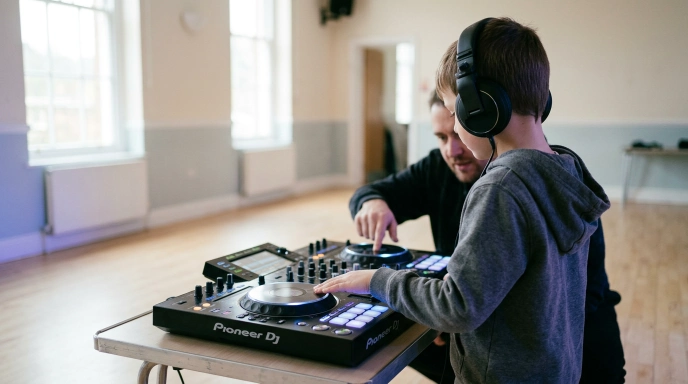
The room is set up for small hands. A little controller, children’s decks, pads and instruments, all of it out on low tables and all of it there to be picked up and pressed and banged. Nothing is precious and nothing is off limits. Sessions run on games and movement rather than sitting still and being shown. We count beats together and clap on the first one, which sounds simple until you watch a room of 4 year olds land it at the same time.
Most of it happens out loud through the speakers, so everyone hears what everyone else is making. There is some headphone time too, mostly because they love putting them on.
45 minutes is about right at this age. Long enough to get properly stuck into something, short enough to finish before anyone runs out of steam.
Your child comes out having had fun. They have also started to hear that music has a shape, and they have stood in front of other people and made a sound on purpose. At 4, that is a big thing to have done.
DJ Kids: Ages 5 to 10
This is where it starts to look like proper DJing, and where most children fall for it.
They work towards getting two tracks playing in time with each other. They play with loops, effects and the sound pads, and learn how a song is put together, the intro, the build, the drop. They play short sets to the group and take on team mixing challenges, which usually get competitive.
There is a moment in this age range that parents notice before their child mentions it. Getting two tracks to lock together takes real concentration, and it does not work, and it does not work, and then it does. Your child looks up. That look is why a lot of them keep coming.
Two children on one controller have to agree what happens next, and the music tells them straight away whether they got it right. It is an easier lesson in working together than most, because nobody has to referee it.
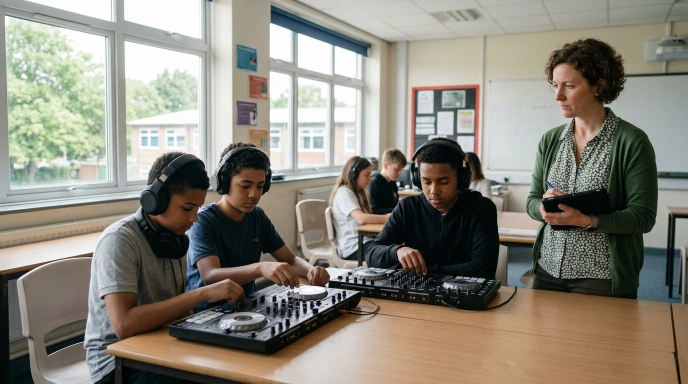
This is also the age group we work with in schools. If your child has done DJing at school and wants to carry on properly, our group sessions pick it up from there.
DJ Teens: Ages 10 to 15
Teenagers who join us have usually never mixed before. What is different at this age is how fast it becomes theirs.
They work towards beatmatching by ear, with and without sync. They move between tracks using EQ, the crossfader and phrasing. They mix in key, try creative blends, and use scratching, loops and effects on purpose rather than by accident. And they record what they make.
The recording changes everything. A mix that exists as a file is one they will play back, send to their friends, and then want to do again better. It is the only thing we do that reliably gets teenagers practising without being asked.
This is also the age when everything competes for their attention, and when being visibly good at one thing starts to matter. A 14 year old who is the best in the room at something takes that with them into everything else.
DJ Youth: Ages 15 and Over
The oldest group works towards the standard of a working DJ. Manual beatmatching, harmonic mixing, live remixing, moving confidently between genres, recording full-length mixes and playing live. There is a first go at music production and at building a profile as an artist.
Plenty start from nothing at 16 or 17 and move quickly, because they chose it themselves rather than being signed up for it.
How Long Before You Notice a Difference?
Your child will play something in their first session. Not a polished mix, but something they made, and they will want to tell you about it in the car.
The change most parents notice takes a bit longer. Somewhere around 7 to 12 sessions, the nerves go. They stop looking at the instructor before trying something and just try it. They stop apologising when it goes wrong. They ask to have another go at the thing they found hard.
That is the point where it stops being an activity you take them to and becomes something they do. Some get there sooner, some take longer, and neither says anything about how good they will be.
What If Your Child Is Shy, or You Are Not Sure They Will Take to It?
This is the most common thing parents ask us, and it is almost never about age.
What helps a child get on with DJing is holding their attention on one thing for a few minutes, and being willing to have a go in front of someone else. That is genuinely it. Plenty of 5 year olds manage both. The ones who take a while to warm up usually get there faster than their parents expect, because there is a lot to touch and nobody is asking them to perform.
Our age groups overlap at the edges on purpose. A 5 year old could be in DJ Tots or DJ Kids, and we would rather put your child where they will do well than where their birthday says they belong. If you are not sure, tell us a bit about them and we will suggest which one to try.
Groups suit most children. They are more fun, there is someone to show off to, and the team elements only work with other children in the room. Groups are capped at 12 so nobody spends the session at the back watching.
One-to-one is better if your child is well ahead of their age group, if they are working towards a performance, or if a group would be hard for reasons that have nothing to do with music. We adapt sessions as standard for sensory needs, extra processing time and fine motor control, so a group is usually still worth trying first.
What You Need to Bring
Nothing.
We bring the decks, the speakers and a pair of headphones for every child. Nobody needs to own equipment and nobody needs any experience. Your child does not need to be musical, and it does not matter if they have never touched an instrument.
Every one of our instructors is DBS-checked with full safeguarding training in place.
Come and Try It
We run DJ classes for kids and teens across Essex and east London, in small groups, one-to-one, during the school holidays, and as birthday parties for ages 6 and up.
The easiest way to find out whether your child will love it is to bring them and watch. You will know within about 10 minutes, and so will they.