The Department for Education published its enrichment framework on 15 June 2026. From September 2026, Ofsted will consider your enrichment offer against it as part of how it assesses personal development.
Most of what has been written about it since is aimed at schools in the Enrichment Expansion Programme. This post is for everyone else, and the good news is that it is a smaller job than it looks.
In this post
- What the DfE Enrichment Framework actually requires, in plain terms, and what it does not
- Why the 400 schools inside the expansion programme are not the ones most affected
- The four benchmarks an external arts partner can genuinely help you evidence
- Three things worth doing before September, and what we can take off your desk
What the DfE Enrichment Framework actually is
Eight benchmarks, across five categories of enrichment: arts and culture, sport, nature, civic engagement and life skills. It came out of the Curriculum and Assessment Review led by Professor Becky Francis, whose final report landed in November 2025.
It is non-statutory. No school is legally required to adopt it. There is no such thing as being enrichment framework compliant, and anyone selling you that is selling you something that does not exist.
What is true is that from September 2026, Ofsted considers enrichment under personal development and wellbeing, and personal development is one of the five evaluation areas under the inspection framework that came into force in November 2025. Inspectors will be looking at whether your enrichment is purposeful and varied, having regard to the framework where applicable.
There is a second thing happening at the same time that has had less attention. Parents will be able to see your enrichment offer through new school profiles. So the framework is not only an inspection question. It is a public-facing one.
The gap nobody is talking about
The DfE Enrichment Framework Expansion Programme is a £22.5 million initiative providing funding and coordination staff to help schools build their offer. It covers 400 schools across nine regions.
There are more than 4,000 schools expected to meet the same standards without it.
If you are in that second group, your position is straightforward and slightly unfair. Same benchmarks, same inspection, no coordinator, no additional budget, and an enrichment offer that probably already exists in fragments across a dozen staff members’ goodwill.
The framework does not require you to build something new. It requires you to be able to describe, evidence and improve what you have. That is a different and much more manageable problem, and it is worth separating the two before you start.
Where arts and culture usually falls down
Of the five categories, arts and culture is the one most schools find hardest to evidence honestly.
Sport has fixtures, teams and attendance registers. Civic engagement has school council minutes. Arts provision, in a lot of schools, means a choir that eleven students attend, peripatetic lessons that families pay for, and a drama production once a year.
None of that is a criticism of the schools. It is what fifteen years of pressure on the arts has produced. GCSE Music entries have fallen by around a third since the early 2010s, and 42% of state schools in England no longer enter any students for the qualification at all, according to the Culture Learning Alliance. Music teacher recruitment has fallen sharply over the same period.
The result is that the students most likely to benefit from creative provision are the least likely to be getting it, and the school has very little to show an inspector when asked.
What a strong arts offer looks like against the benchmarks
Four of the eight benchmarks are where an external arts provider can do real work.
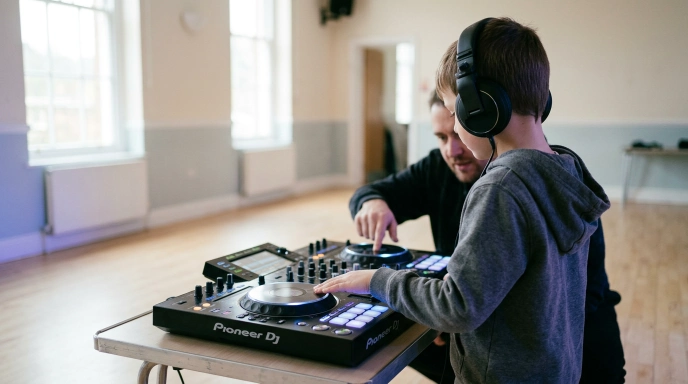
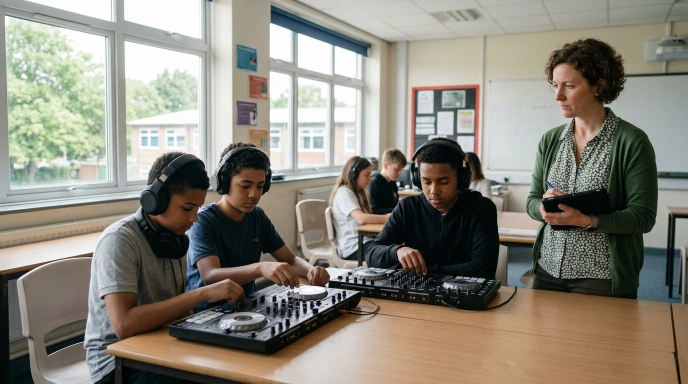
Benchmark 2, a broad and well-rounded offer. The point here is breadth, not volume. A choir and an orchestra are both music, but they reach a similar kind of student. Something structurally different, whether that is music technology, production, DJing or sound engineering, reaches students who have never signed up for an instrumental lesson in their lives. That is what breadth means in practice.
Benchmark 3, accessible to all. The question to ask about any activity is what it costs a family and what it assumes a student already has. If participation depends on owning an instrument, paying for lessons, or having a parent free to collect at 5pm, it is not accessible, whatever the sign-up sheet says.
Benchmark 5, tracked and evidenced. This is where most schools lose ground, and it is the easiest to fix. Attendance, engagement, skills progression and a written record per student. If your external providers are not giving you this, ask them for it. Any provider worth booking will already have it.
Benchmark 6, partnership with external providers. Governance documents, safeguarding policies, DBS checks, insurance. Straightforward to evidence and worth having on file before anybody asks.
The remaining benchmarks sit with your leadership, strategy and planning rather than with a provider. No external partner can do those for you, and anyone claiming otherwise has not read the framework.
What to do between now and September
The framework comes with a self-assessment and action planning tool. It is worth an hour of somebody’s time before term starts.
Beyond that, three things:
Write down what you already do. Most schools underestimate their own offer because it is distributed across staff who do not think of it as enrichment. The trip, the club, the visiting workshop, the assembly programme. Get it on one page.
Find the honest gaps. Not the ones that sound good to name, the real ones. Which students are not taking part in anything? What does your arts offer look like to a Year 9 who does not sing, does not play an instrument and has never been in a school production?
Sort out evidence for next year, not last year. You cannot retrospectively track a club that ran in 2025. You can put something in place for the autumn term that gives you a full year of data by the time it matters.
Where we fit
DJ Club CIC delivers structured, curriculum-linked music technology workshops in schools across London and Essex. Three terms, covering DJing, music production and sound engineering, with a live showcase at the end. We bring all the equipment, so there is no cost to students or families.
We provide a termly report for every group covering attendance, engagement, skills progression and a written summary for each student, which is designed to be used directly in your enrichment evidence.
If you want to talk it through, or see a session before committing to anything, we run free demo sessions for schools in Havering and the surrounding area.
Check out our work we do with schools here.